








Not if the migration is done properly. The critical factor is the 301 redirect plan: every URL on your WooCommerce store has to redirect to its Shopify equivalent so Google transfers the authority you have accumulated. When that mapping is done well, rankings are preserved and often improve, thanks to Shopify’s stronger technical performance. SEO loss in migrations is almost always down to redirects that were badly planned or missing altogether, which is exactly what a professional process prevents.
WooCommerce to Shopify Migration

Migrating from WooCommerce to Shopify is one of the decisions that most improves how an ecommerce business performs: you leave behind server maintenance, plugins and updates, and you gain speed, stability and a checkout proven at global scale.
But a badly executed migration can destroy months of search rankings and create operational losses. At STRAT, as an official Shopify Partner, we handle the whole process: catalogue, customers, order history and 301 redirects to keep your organic traffic intact from day one.

Why migrate from WooCommerce to Shopify

The end of technical maintenance
On WooCommerce you are responsible for hosting, updates, security, backups and compatibility between plugins. On Shopify the platform handles all of it. The time and budget that goes into maintenance gets reinvested in growth.

Speed and stability
WooCommerce performance depends on your hosting and on how many plugins have piled up. Shopify is cloud-native with a global CDN: it performs better out of the box, without you having to optimise infrastructure. That has a direct effect on conversion and SEO.

An optimised checkout
Shopify's checkout has been tested across billions of transactions and competes on conversion with Amazon's. Every improvement Shopify ships reaches your store automatically, with no development work.

Ecosystem and scalability
Shopify's app ecosystem solves natively what WooCommerce needs plugins for, plugins you then have to maintain and that conflict with one another. Scaling is simpler and more predictable.
What we migrate from your WooCommerce store
A complete migration is not just moving products. It means transferring all the value your store has accumulated without losing data or rankings. This is what we migrate in full.
- The complete catalogue: products, variants, collections, categories, images and attributes.
- Customer base: accounts, addresses and history, with their data consent intact.
- Order history: to preserve your business history and your analytics.
- Content: pages, blog and resources, with their structure.
- SEO and URLs: full URL mapping and 301 redirects to preserve your rankings.
- Integrations: reconnecting the stack (ESP, reviews, analytics) inside the Shopify environment.
Our risk-free migration process
In a platform migration, the most sensitive asset is the search authority your store has built over years. Our process protects it at every step, from the redirect map through to post-launch monitoring.

1. Audit and mapping
We analyse your current WooCommerce store: catalogue, URL structure, organic traffic, integrations and data. We define the migration plan and the redirect map before touching anything.

2. Building on Shopify
We develop the new store in a staging environment, replicating and improving the structure, with the catalogue and content imported and validated.

3. The 301 redirect plan
We design the full redirect map from every old URL to its Shopify equivalent. This is the step that preserves your search rankings, and the one that accumulates the most errors when it is handled by someone without experience.

4. Go-live and validation
We run the launch with technical cover, validate that everything works (data, redirects, integrations, tracking) and monitor SEO behaviour over the following weeks to correct any drift.
What is at stake in a badly executed migration
A platform migration touches the most sensitive asset in your ecommerce business: the search rankings you have spent years building. A migration without a correct 301 redirect plan can cause a loss of organic traffic that lasts months, mass 404 errors that Google penalises, the loss of customer and order history, and a drop in deliverability if the email integrations are not reconnected properly. Most of these problems are irreversible in the short term and expensive to recover from. That is why a migration is not a minor technical task: it is a project that determines the continuity of your business.
Official Shopify Partner
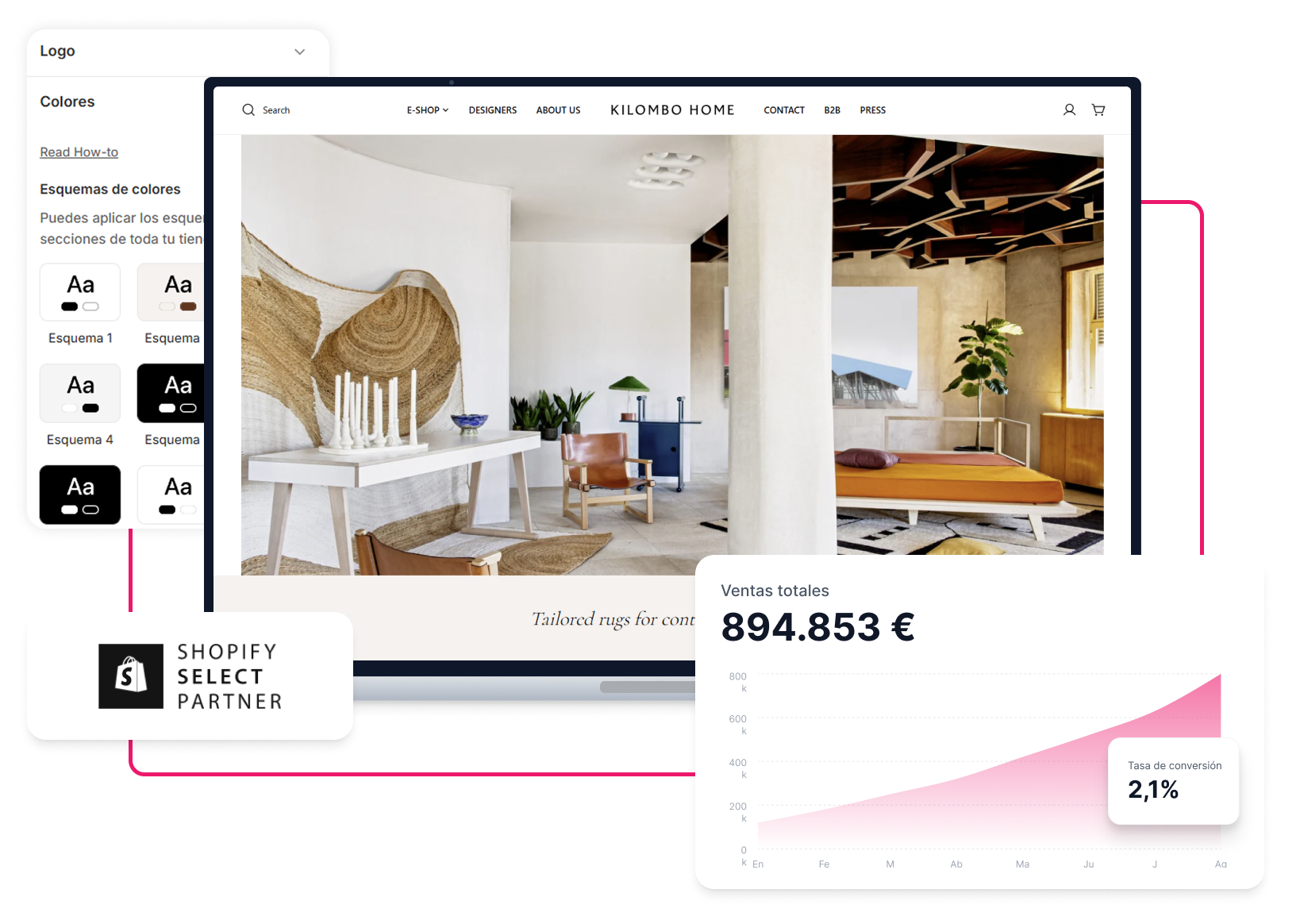
As an official Shopify Partner, STRAT is recognised for building and migrating high-performance ecommerce stores on Shopify and Shopify Plus. That partnership is not decorative: in a migration it is a direct guarantee that the project is run to the platform’s official standards and technical knowledge.
-
- Direct access to Shopify support and betas: a priority channel with the platform to resolve any incident during the migration quickly, without depending on standard support timelines.
- Official technical knowledge of the platform: we migrate applying Shopify’s official best practice on catalogue structure, variants, metafields and architecture, making sure the new store does not just replicate the old one but starts from a solid technical base.
- SEO preservation as a priority: the biggest risk in a migration is losing rankings. We treat the 301 redirect plan and the URL structure with the priority they deserve, because hard-won SEO is one of the most valuable assets being transferred.
- Migration integrated with paid and retention: we do not hand over an isolated store. The new Shopify store comes connected to your acquisition and retention strategy and optimised to convert, not just to function.
Verify our credentials in the official Shopify Partners directory.
Why STRAT?

We are not a developer who does the occasional migration. We work exclusively with ecommerce and Shopify migration is one of our regular services as an official Shopify Partner. We understand that the critical part of a migration is not moving products, it is preserving search rankings, business history and email deliverability.
That is why we integrate the migration with your store’s full strategy: we do not just move you to Shopify, we leave the new store optimised to convert and connected to your acquisition and retention. Every decision is made on commercial criteria, not just technical ones.
Our latest case studies
Want to migrate from WooCommerce to Shopify without the risk?
Frequently asked questions
Yes. We migrate the complete customer base (with their data consent), the order history and the associated data. Keeping that history matters both for operational continuity and for business analytics, and it means your retention and segmentation strategy keeps working from day one on Shopify.
It depends on catalogue size, the complexity of your integrations and the volume of content, but a well-planned standard migration is usually completed in four to eight weeks, including audit, staging build, redirect plan, validation and go-live. The timeline is set out in the initial audit with verifiable milestones.
No. We build the new store in a parallel staging environment while your WooCommerce store stays live and selling. The switch happens in a controlled way at go-live, minimising any interruption, with technical cover to resolve issues immediately.
We reconnect them inside the Shopify environment as part of the process. This is particularly critical for email: a badly handled reconnection of your ESP (Klaviyo, Omnisend or another) can affect deliverability. Since we are also a Klaviyo and Omnisend Partner, we handle that part with the care it needs so your retention programme does not suffer during the change.