












Meta Ads Agency
for Ecommerce Brands

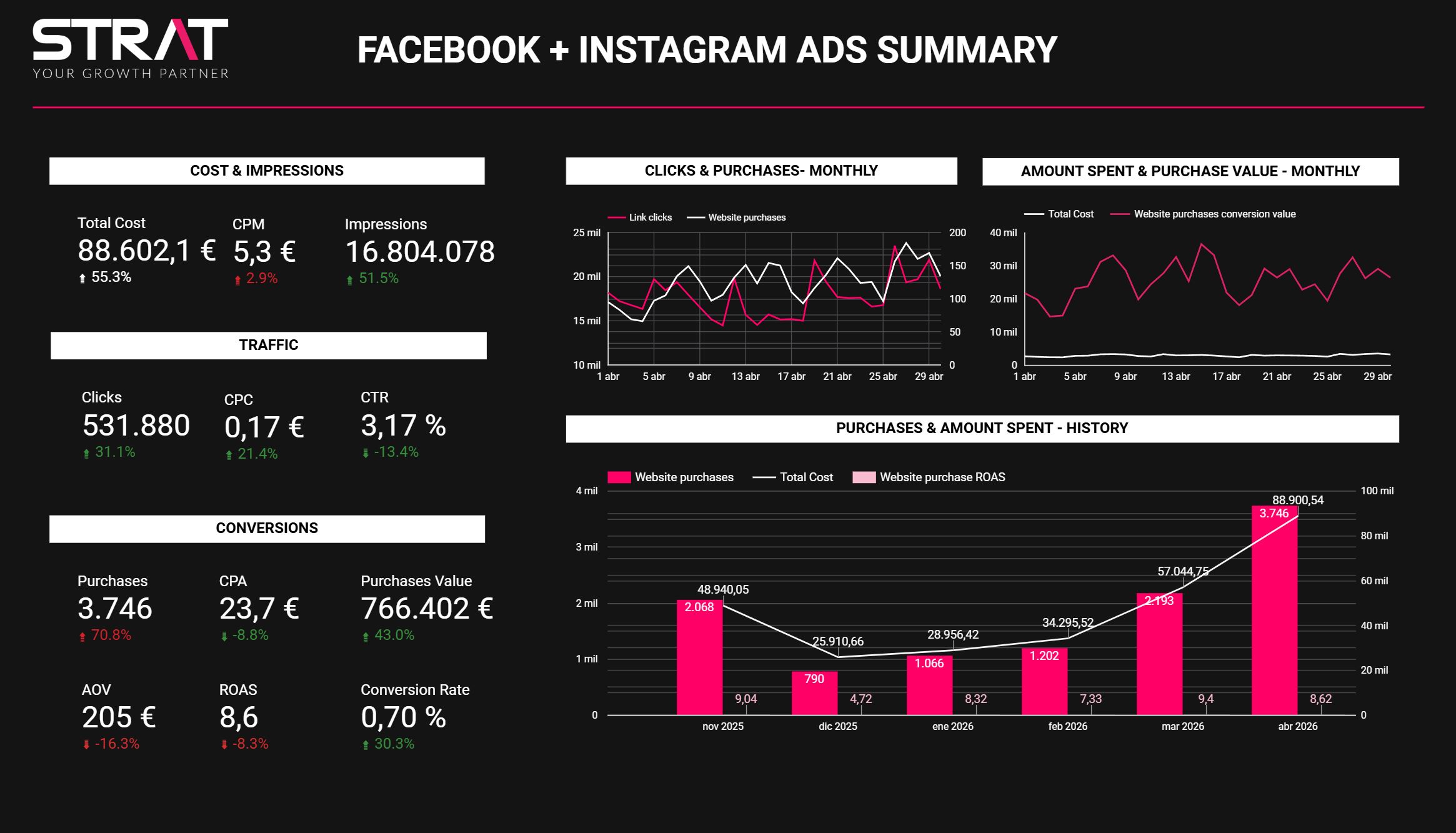
We run Meta Ads across Facebook and Instagram as the main acquisition engine for ecommerce brands. Meta still brings in new customers at more volume than any other channel across most DTC verticals, and it is also the channel that saturates audiences fastest and drives CAC up when it is run without discipline.

As an official Meta Business Partner, we combine broad-audience prospecting, dynamic catalogue retargeting and signal recovery through the Conversions API, and we measure in POAS rather than platform ROAS.

What sets Meta Ads apart in ecommerce

We manage Meta end to end, from the technical measurement base through to creative strategy and scaling. Every decision is validated with data and tied to the real impact on the profitability of the business. This is how we approach each front.
Evaluation and Migration icon

Audience saturation and the scaling ceiling

Audiences on Meta saturate as spend increases. Without constant creative renewal and a diversity of angles, frequency climbs, CTR falls and CAC rises with it. Sustainable scaling on Meta depends more on the pace of creative production than on the size of the budget.

Signal loss after iOS and the role of the Conversions API

Since iOS 14.5, Meta receives less conversion signal, which weakens how well the algorithm optimises. Implementing the Conversions API server-side, and implementing it well, recovers much of that signal. It is now a technical requirement, not an optional extra.

Creative as the new targeting

With detailed targeting increasingly restricted, the creative is what determines who Meta reaches. Creative strategy (angles, formats, hooks) is the real performance lever, ahead of any audience configuration.
Automation icon

Advantage+ Shopping and automation used with judgement

Advantage+ Shopping does a lot of the work that used to be manual, but handing the whole account over to it is not a strategy. It performs when the catalogue, the events and the creative feeding it are in order, and when the manual campaigns running alongside it cover what ASC does not. We decide the split between automated and manual campaigns based on the stage your brand is at, not on a fixed template.

Average results across ecommerce clients (first 12 months)

120%

Revenue growth

80%

POAS improvement

3x

Average LTV/CAC ratio

-20%

CAC reduction

How we manage your Meta Ads campaigns

Account and campaign structure

We design account structures that separate prospecting and retargeting with clear intent, balancing Advantage+ Shopping against manual campaigns according to the stage your brand is at, and avoiding the audience overlap that cannibalises the algorithm's learning.

Conversions API and server-side measurement

We implement the Conversions API server-side to recover the signal lost after iOS, configure custom events around the actions that matter to your business, and validate signal quality on an ongoing basis.

Creative strategy and production

We run a constant creative testing pipeline: angles, formats (video, static, UGC, carousel), hooks and value propositions. Continuous creative renewal is what keeps CAC under control as you scale.
Strategy icon

Dynamic catalogue retargeting

We set up the catalogue and dynamic retargeting campaigns (DPA) to recover conversions from users who have already engaged, without cannibalising organic conversions or inflating apparent ROAS.

Creative as the performance engine on Meta

With detailed targeting increasingly restricted, on Meta it is the creative that decides who each ad is shown to. The algorithm finds your customer through the creative, not the other way round. That is why we keep a constant testing pipeline running: new angles, new formats (video, static, UGC, carousel) and hooks built to stop the scroll in feed and Instagram Stories.

We iterate every concept against real performance data, scaling the creative that converts profitably and retiring the creative that fatigues, which on Meta happens quickly. That continuous renewal of assets is what keeps CAC under control as you scale spend.

Real measurement, beyond ROAS

The ROAS reported in Meta Ads Manager is misleading. It counts view-through conversions, it takes credit for sales that would have happened anyway, and it has no knowledge of your real margin. That is why we measure in POAS (Profit on Ad Spend), factoring in the margin on each sale, returns and true product cost, so you can see which campaigns generate profit and which only generate revenue. Combined with the Conversions API to recover the signal lost after iOS, you get a reliable read on which part of your Meta spend is putting real money into your P&L.

Why STRAT?

We are not a generalist agency that also runs Meta Ads. We work only with ecommerce, and Meta is one of the channels we have run in the most depth. We know the real CPM, CTR and CAC benchmarks by vertical, and we know platform ROAS misleads unless you read it against actual margin and return rate.

We apply that specialisation as an official Meta Business Partner, with access to priority support and product betas. Every decision on your account is made against tested business criteria and reported in POAS connected to your P&L, not in isolated platform metrics.

Considering Meta Ads for your ecommerce brand?

Frequently Asked Questions

Yes. For most ecommerce brands, Meta is still the channel that brings in new customers at the greatest volume. What has changed is how it has to be run. Audience saturation, signal loss after iOS and the restrictions on detailed targeting call for a strategy built around creative, server-side measurement through the Conversions API, and account structures that use Advantage+ automation with judgement. Managed properly, it remains the primary acquisition engine.

The Conversions API (CAPI) is Meta’s method for sending conversion events from the server rather than only from the browser. After the iOS privacy changes, the pixel loses part of the conversion signal, which degrades how the algorithm optimises. Implementing CAPI server-side recovers a large part of that signal, improves attribution and lets Meta optimise against more complete data. It is now a basic technical requirement for any ecommerce brand investing seriously.

The minimum depends on your vertical, your average order value and your objective. More important than the starting figure is that it is enough for the algorithm to exit the learning phase and to sustain a creative testing pace that supports scaling. A budget that is too small, spread across too many campaigns, stops any of them from accumulating enough data. We define the right budget for your specific case in the initial audit.

Platform ROAS measures revenue against ad spend, but it takes no account of the real margin on each sale. A campaign at 4 ROAS can lose money if product margin is thin, and one at 2 ROAS can be excellent if margin is high. POAS (Profit on Ad Spend) incorporates real margin, which lets you make investment decisions based on profit rather than gross revenue.

Meta performs best inside a full-funnel strategy. We coordinate it with Google and TikTok according to the stage of the funnel, and with the retention side (Klaviyo, Omnisend), measuring performance on blended MER and blended POAS rather than Meta’s ROAS in isolation. That integrated view is what prevents channels from cannibalising each other and shows the real impact on the business.